For a long time, I was using a Supermicro A2SDI-H-TF with an Intel Atom C3758 as my home server. One big problem was its lack of AVX support, causing abysmal performance with ZFS native encryption. So I "upgraded" to a second-hand X10SDV-8C+-LN2F. However, after upgrading the IPMI firmware, I noticed that FAN4 was missing from my sensors.
After some googling, I found a Reddit post describing the exact same issue. They figured out that, somehow, newer IPMI firmware versions don't install the sensor correctly. Apparently, you can perform a specific firmware upgrade dance to get it working again.
I could reverse engineer all the firmware dumps, figure out what's different, and see if I could restore the sensor using ipmitool or something similar. However, this isn't exactly high on my priority list. BUT luckily (and also sadly), LLMs are getting crazy good at this stuff. So why not just spend an hour fixing it properly!
After a bunch of prompts with Claude, followed by spending way more time than expected making the shell script nice, I ended up with sensor.sh, which is also listed below.
The script restores FAN4 (FANA) and even restores the missing 10G temperature sensor in some specific situations where it's also missing. I tested it on my board, and it works great! The only downside is that the sensor entry gets appended to the end of the sensor list. There's no way to fix that without rebuilding the entire table, which I don't think is worth it!
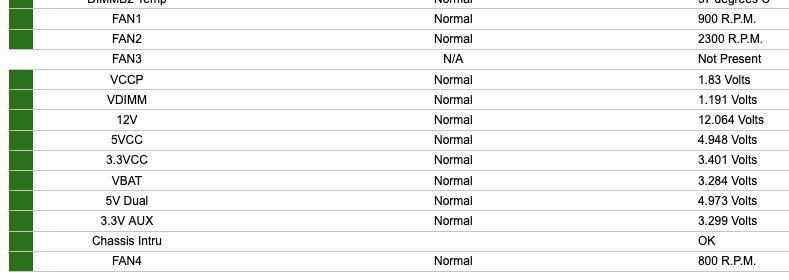
This avoids the whole firmware upgrade dance and allows you to do a full reset of the BMC settings, which is recommended.
#!/bin/sh
# x10sdv-fan4-sdr.sh add|remove
#
# Some Supermicro X10SDV motherboards lose their FAN4 sensor after upgrading
# the BMC firmware. In some cases, the MB_10G Temp sensor also disappears.
#
# BMC firmware 4.0x (PreInitFuncX10SDV in libipmi.so) selects the sensor table
# based on three things:
#   - The PCB 2.00 hardware strap
#   - The 12C/16C hardware strap
#   - The "10G Lan" setting in /nv/system.conf
#
# When "10G Lan" is disabled, the firmware selects an LN2 sensor table. These
# tables are essentially the 10G tables without the PHY temperature sensor,
# but with the PCB version suffixes swapped. As a result, a PCB 2.00 board
# gets SDRBlock.X10SDV_LN2_2_0, which is missing FAN4.
#
# This means the fourth fan header is no longer monitored or assigned to a
# fan zone. A TLN4F board that loses its "10G Lan" setting can end up using
# the same table, losing both FAN4 and MB_10G Temp.
#
# This script restores the missing sensor records directly, without having
# to do the whole firmware downgrade/upgrade dance.
#
#   add     Restores FAN4 on affected LN2F and TLN4F boards, and MB_10G Temp
#           on supported TLN4F boards. Existing sensors are skipped, so
#           running the command multiple times is safe.
#
#   remove  Removes FAN4 and MB_10G Temp, regardless of whether they were
#           added by this script or by the firmware. Use with care!
#           Running add again restores the records on supported boards.
#
# The 12C/16C boards already have the fourth fan header defined as FANA
# (sensor 45h) and are intentionally left alone.
#
# The records below are copied from Supermicro's own firmware:
# SDRBlock.X10SDV_2_0 in versions 3.46 and 4.07. The records are identical
# between these versions. FAN4 is also present in SDRBlock.X10SDV_LN2_1_0.
#
# Add SDR appends records to /nv/SDRBlock. They survive BMC restarts and
# firmware updates performed with "Preserve SDR" enabled. A BMC restart may
# be needed before the restored sensors actually report readings.
#
# One small downside: the restored sensors appear at the end of the sensor
# list. Fixing the order would require rebuilding the entire SDR table,
# which I don't think is worth it!

# FAN4 sensor record (IPMI 2.0, Table 43-1: Full Sensor Record).
# Identical to the firmware's FAN3 record, except for the sensor number,
# entity instance and name.
#
# Bytes  Value           Description
# ----- --------------- -----------------------------------------------
#  1-2   00 00           Record ID (assigned by the BMC)
#  3-5   51 01 2f        SDR version 1.5, full record, 47 bytes of data
#  6-7   20 00           Owner: BMC, LUN 0
#  8     44              Sensor number (FAN1-3 use 41h-43h)
#  9-10  1d 04           Entity: fan, instance 4
# 11     7d              BMC initializes sensor; scanning enabled
# 12     68              Auto re-arm; thresholds/hysteresis configurable
# 13-14  04 01           Fan sensor, threshold-based readings
# 15-18  14 7a 14 7a     Enabled lower/upper threshold events
# 19-20  3f 3f           All six thresholds readable and configurable
# 21-23  00 12 00        Unsigned reading, unit RPM
# 24-30  00 64 00 00
#        00 00 00        Linear conversion: RPM = raw value * 100
# 31-34  07 80 aa 14     Nominal 12800, normal range 2000-17000 RPM
# 35-36  ff 00           Sensor range: 0-25500 RPM
# 37-39  ff fe fd        Upper thresholds: 25500, 25400, 25300 RPM
# 40-42  03 05 07        Lower thresholds: 300, 500, 700 RPM
# 43-47  00 00 00
#        00 00           No hysteresis; reserved/OEM fields
# 48     c4              ASCII name, 4 characters
# 49-52  46 41 4e 34     "FAN4"
fan4='00 00  51 01 2f  20 00  44  1d 04  7d  68  04 01  14 7a 14 7a  3f 3f  00 12 00
      00 64 00 00 00 00 00  07 80 aa 14  ff 00  ff fe fd  03 05 07  00 00 00 00 00
      c4 46 41 4e 34'

# MB_10G Temp sensor record (same IPMI Full Sensor Record format).
# Restores the temperature sensor for the onboard 10G PHY.
#
# Bytes  Value           Description
# ----- --------------- -----------------------------------------------
#  1-2   00 00           Record ID (assigned by the BMC)
#  3-5   51 01 36        SDR version 1.5, full record, 54 bytes of data
#  6-7   20 00           Owner: BMC, LUN 0
#  8     0d              Sensor number (other temps use 0bh and 0ch)
#  9-10  07 04           Entity: system board, instance 4
# 11     7f              Sensor initialization, scanning and events enabled
# 12     68              Auto re-arm; thresholds/hysteresis configurable
# 13-14  01 01           Temperature sensor, threshold-based readings
# 15-18  14 7a 14 7a     Enabled lower/upper threshold events
# 19-20  3f 3f           All six thresholds readable and configurable
# 21-23  80 01 00        Signed reading, unit degrees Celsius
# 24-30  00 01 00 00
#        00 00 00        Linear conversion: degrees C = raw value
# 31-34  07 2d 43 fc     Nominal 45 C, normal range -4 to 67 C
# 35-36  7f 80           Sensor range: -128 to 127 C
# 37-39  69 64 5f        Upper thresholds: 105, 100, 95 C
# 40-42  fb 00 05        Lower thresholds: -5, 0, 5 C
# 43-47  03 03 00
#        00 00           Hysteresis: 3 C in either direction; reserved/OEM
# 48     cb              ASCII name, 11 characters
# 49-59  4d 42 5f 31
#        30 47 20 54
#        65 6d 70        "MB_10G Temp"
mb_10g='00 00  51 01 36  20 00  0d  07 04  7f  68  01 01  14 7a 14 7a  3f 3f  80 01 00
        00 01 00 00 00 00 00  07 2d 43 fc  7f 80  69 64 5f  fb 00 05  03 03 00 00 00
        cb 4d 42 5f 31 30 47 20 54 65 6d 70'

set -eu

# Find a sensor record by its sensor number (hex, without 0x).
#
# Walk the SDR repository using Get SDR (0x23). Offset-zero reads don't
# require a reservation. Each response contains the next record ID followed
# by the current record's header and sensor number.
#
# On success, set $id to the matching record ID ("lsb msb") and return 0.
# Return 1 if the sensor doesn't exist. Abort on malformed responses rather
# than accidentally treating a failed read as a missing sensor.
record_id() {
    num=$1 next=0000
    while [ "$next" != ffff ]; do
        set -- $(ipmitool raw 0x0a 0x23 0 0 "0x${next#??}" "0x${next%??}" 0 8)
        [ $# -ge 10 ] || { echo "Get SDR failed at record $next" >&2; exit 1; }
        id="$3 $4" next=$2$1
        case "$6 ${10}" in "01 $num" | "02 $num") return 0 ;; esac
    done
    return 1
}

# Add a sensor record using Add SDR (0x24), unless its sensor number already
# exists in the repository. This makes the operation safe to repeat.
add_record() {
    set -- $1
    if record_id "$8"; then
        echo "sensor ${8}h already present"
    else
        # Prefix every byte with 0x so ipmitool interprets it as hexadecimal.
        ipmitool raw 0x0a 0x24 $(printf '0x%s ' "$@") >/dev/null
        echo "added sensor ${8}h"
    fi
}

command -v ipmitool >/dev/null || { echo 'ipmitool not found' >&2; exit 1; }

case ${1:-} in
add)
    board=$(cat /sys/class/dmi/id/board_name 2>/dev/null || echo unknown)
    case $board in
    X10SDV-TLN4F* | X10SDV-[468]C*-TLN4F*) add_record "$fan4"; add_record "$mb_10g" ;;
    X10SDV-[468]C*-LN2F*)                  add_record "$fan4" ;;
    *) echo "not affected or unknown board: $board" >&2; exit 1 ;;
    esac
    ipmitool sdr type fan
    echo 'A sensor without a reading needs a BMC restart: ipmitool mc reset cold'
    ;;
remove)
    # Delete SDR (0x26) requires a reservation from Reserve SDR (0x22).
    # Each deletion invalidates the reservation, so obtain a new one and
    # look up the record ID again before deleting the next record.
    for num in 44 0d; do
        while record_id $num; do
            reservation=$(ipmitool raw 0x0a 0x22)
            set -- $reservation $id
            ipmitool raw 0x0a 0x26 "0x$1" "0x$2" "0x$3" "0x$4" >/dev/null
            echo "removed sensor ${num}h"
        done
    done
    ;;
*)
    echo "usage: $0 add|remove" >&2
    exit 2
    ;;
esac